WWEA Annual Report 2025: Record Growth and Emerging Challenges
WWEA Annual Report 2025
The report can here be downloaded in pdf format
The WWEApodcast 25: Global Wind Power – How to Reach 10 Million MW by 2050 https://wwindea.org/WWEApodcast25
#WWEAwebinar Wind Power Around the World Recordings: https://youtu.be/60ladqA9ZlE
Global Wind Power in 2025: Record Growth and Emerging Challenges
Highlights:
• Global wind capacity exceeds 1’346 Gigawatt
• 169 Gigawatt added in 2025, 35% more than 2024
• Wind power generates close to 3000 TWh, more than 11% of world demand
• Annual growth rate rises from 11,9% to 14,3% – highest since 2020
• China installs 130 Gigawatt, 49% more than in 2024, 77% of global market
• World outside China: 11,7% more new wind than 2024 but still below 2023
• India becomes second largest market for new wind
• 1’500’000 Megawatt of global capacity to be reached in 2026
• World to target octuplication to 10’000’000 MW, covering 40% of demand
• Required growth: 350’000 MW per year
A Year of Unprecedented Expansion
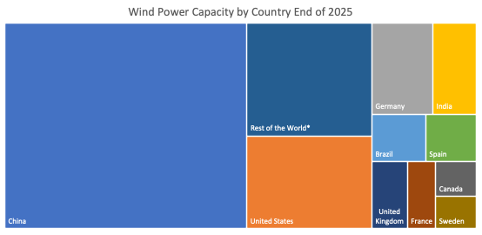
2025 marked a watershed moment for the global wind power sector. According to preliminary statistics released by the World Wind Energy Association (WWEA), the world added 169’014 Megawatts (MW) of new wind capacity – a 35% increase over 2024 – bringing total global installations to 1’346’866 MW. This surge represents the highest annual growth rate since 2020, with wind power now generating nearly 3’000 terawatt-hours (TWh) of electricity and meeting over 11% of global demand.
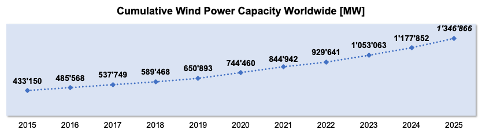
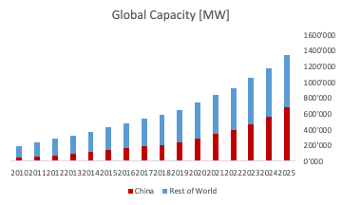
The record-breaking expansion was overwhelmingly driven by China, which alone accounted for 77% of global additions by installing 130 Gigawatts (GW) in a single year. China has now an overall share of more than 50% of the world total capacity.
Outside China, however, growth remained uneven. While new installations reached 38,7 GW – slightly above 2024 levels – this figure still fell short of the 44 GW added in 2023. The disparity underscores a critical trend: the wind power boom is concentrated in a handful of countries, with China, India, Vietnam, Chile, and Turkey leading the charge, alongside modest contributions from traditional markets like Germany and the United States.
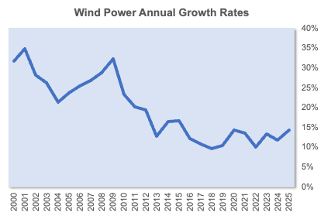
The volume of the capacity added results in a global growth rate of 14,3%, significantly higher than in 2024, when wind capacity grew by only 11,9%. Since 2016, only the year 2020 showed a similar growth rate, all other years had lower global growth.
Of the top thirty countries, only five had growth rates above the global average: China with 23,2%, Turkey with 15,5%, the most dynamic market Vietnam with 2025’s record rate of 50,8%, as well as Chile with the second dynamic market and 23,9% increase. India with 13,1% showed a dynamic momentum as well although slightly below the global average.
Some of the previously very strong markets saw a very modest growth of less than 7%: USA 4,1% (up from 2,8% in 2024), Germany 6,3% (4,6% in 2024), United Kingdom 3,1% (a drop from the 6,4% in 2024), and Spain 3,3% (4,5%). Brazil 6,7% (substantially less than 17,7% in 2024), and France 5,2% (5,8%) also slowed down wind power deployment.
The countries with the largest market volume for new wind turbines of more than 2 GW of added capacity were in 2025: China (130 GW), India (6300 MW), followed closely by the United States (6272 MW), Germany (4602 MW), Vietnam (2493 MW), Brazil (2244 MW), and Turkey (2142 MW).
Overall, 46 countries had at the end of 2025 an installed capacity of over 1000 MW, two more than in 2024. The newcomers in the club of the one Gigawatt countries are Serbia and Peru, both adding around 460 respectively 270 MW of new turbines in 2025.
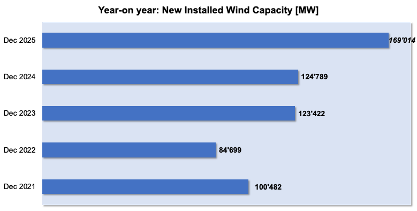
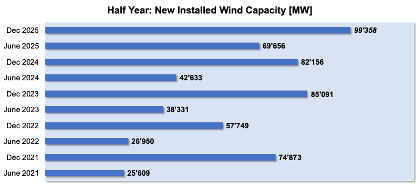
Looking at the growth on semi-annual basis gives an even more differentiated picture. Growth both in the first and in the second half of 2025 was very encouraging and significantly higher than in the previous years. This is the case both on an annual as well as on and semi-annual basis.
Wind Power’s Rising Share in Global Electricity
Wind energy’s contribution to global electricity supply has never been more significant. In 2025, wind turbines generated enough power to cover more than 11% of worldwide demand, surpassing nuclear energy and closing in on other fossil sources. This milestone reflects not only the sector’s rapid expansion but also its increasing reliability as a power source.
At the national level, more than 30 countries now have a share of wind power equal to or above the world average. China generated last year 10,8% of its power from wind, very close to the global average. From this year onwards, China is expected to exceed the global average.
12 countries now generate over 20% of their electricity from wind, with Denmark, Germany, the United Kingdom, the Netherlands, Ireland, and Uruguay leading the way and a share of more than 30%. Denmark, in particular, stands out as a global pioneer, producing more than half of its electricity from wind. These examples prove that a 40% global share by 2050 – as envisioned by the WWEA—is not just aspirational but achievable.
The electrification of transportation, heating, and cooling sectors further amplifies wind power’s potential. As demand for renewable energy surges—driven by electric vehicles, data centers, and industrial decarbonization—wind is poised to become the backbone of a renewable-powered future.
Long-term developments: Stronger rationale and new opposition
With 1’346’866 Megawatt of installed capacity, the world has reached a new record in total installations after it had fallen short of expectations and forecasts for 2024. As expected, some of the new installations originally anticipated for 2024 took place in 2025.
As it can be expected that the growth in China will continue on the same level, the key to achieve more ambitious global targets lies outside China. The rest of the world must accelerate substantially its wind power deployment to achieve more global growth.
While many countries are increasing their efforts to grow their wind sector, recent developments mainly in the US have created enormous uncertainty not only about the future of the US market, but also about the viability and reliability of international supply chains.
Barriers to Accelerated Growth
Despite its promise, the wind sector faces formidable challenges that threaten to slow its momentum:
Political and Regulatory Hurdles
In the United States, the current administration has taken aggressive steps to curtail wind power development, including revoking permits for offshore projects and offering financial incentives to developers who abandon wind farms. These policies not only disrupt domestic progress but also destabilize international supply chains, creating uncertainty for investors and manufacturers worldwide.
Meanwhile, fossil fuel subsidies continue to distort energy markets. Although some governments began phasing out these subsidies following the Ukraine war-induced energy crisis, rising geopolitical tensions and recently skyrocketing oil prices have led to backsliding in many regions.
Permitting and Planning Delays
One of the most persistent obstacles is the prolonged approval process for new wind projects. According to the WWEA, the average permitting timeline exceeds five years—and in some countries, a decade or more. Such delays are untenable in a sector where technology and demand evolve rapidly. Streamlining these processes to two years or less could unlock significant growth, particularly in repowering older turbines, which could triple or quadruple capacity at existing sites.
The fundamental importance of good community engagement
In the light of more and more fake news being spread about wind energy around the globe, direct benefits for people become crucial for the success of wind power. People who know and experience the benefits of wind farms will simply become immune to false information. Therefore and while good community engagement goes hand in hand with rapid growth – as local citizens are often active drivers of wind energy development – vocal opposition to wind farms can have a potentially destructive effect, delaying or preventing wind projects. Accordingly, community-based wind is a key driver, as many cases have shown.
Based on this understanding, WWEA has launched the WWEA Community Engagement Guidelines based on practical experience, during the 22nd World Wind Energy Conference in December 2025 in Shantou/China. The guidelines recommend tools and approaches how to ensure good engagement of communities in terms of information at all stages and also in terms of fair benefit sharing.
It is also worth noting that an increasing number of jurisdictions have begun to establish legal standards for this purpose – community energy laws that require wind farm developers to provide certain forms of community benefits, whether in the form of community shares, low electricity prices, payments to the local community, etc. These laws are sometimes called “community energy laws”.
International frameworks
The US withdrawal from international organisations such as the UNFCCC and the International Renewable Energy Agency IRENA has created additional uncertainty so far as international, often supporting frameworks are concerned. Additional market uncertainty has been created by the ongoing discussions and struggles related to international trade. Contradictory decisions have made trade more difficult. However, in response, several world regions have agreed on new free trade arrangements which will also offer new opportunities for wind power.
So far the US seem to be in a unique role as there is no major trend that other governments would follow the US example. Even traditional oil and gas countries are continuing to invest in renewable energy and wind farms.
Repowering: Opportunity facing challengers
As more than 400’000 MW of the installed wind capacity has already reached a lifetime of ten years and older, replacing these old machines by latest technology offers a great potential. Such repowering may increase the previously installed capacity by a factor 3-4 and should be encouraged by legislation – nowadays repowering projects still often face major regulatory barriers which need to be addressed.
Educating people: Global Collaboration
Training and education has become another major factor that is a precondition for the fast deployment of wind turbines. A large number of countries are still in the infancy phase when it comes to the deployment of wind power. They need well-educated and trained staff to implement and operate wind farms. The establishment of the World Wind Energy Academy (which is headquartered in Shantou, Southern China) presents therefore another milestone for global wind power as it will support international training programmes.
The Road to 10’000’000 MW of Wind by 2050
The numbers show very clearly that the share of wind power in global electricity generation is increasing continuously. In light of the vulnerability of fossil fuel supply chains and the problems related to nuclear power, renewable energy is about to cover close to the entirety of the world’s energy supply. With the global trend towards electrification, it can be expected that wind, jointly with other renewables, will also cover a large share of the energy required for heating and cooling as well as for transportation.
Accordingly, it can reasonably be expected that the world will double its power demand in the coming 25 years. Assuming that, as already achieved in some countries, wind power may have a share of 40% in the overall electricity generation. This will require an overall installed capacity of 10’000’000 Megawatt of wind turbines in the year 2050. This is equivalent to an eightfold increase of the capacity installed today.
Such increase will require annual capacity additions of 300’000 to 400’000 MW, a realistic scenario when considering the growth already happening today which has already reached half of this size. One third or more of this growth can be provided by repowering of existing wind farms. However, this will require governments to set up appropriate frameworks.
WWEA’s long-term vision – 10’000 GW of wind power by 2050, supplying 40% of global electricity demand – is ambitious but achievable. To reach this goal, the world must double to triple annual installations to 300–400 GW per year, with one-third of the growth coming from the repowering of aging turbines.
Key Steps Forward
1. Policy Reform: Governments must eliminate fossil fuel subsidies, accelerate permitting, and incentivize repowering.
2. Improved international collaboration amongst the like-minded governments, enterprises, people, to jointly increase the resilience of the wind community.
3. Supply Chain Resilience: Strengthening international trade agreements and local manufacturing will reduce dependency on volatile markets.
4. Community-Centric Models: Expanding local ownership and benefit-sharing programs can build public support and counter opposition.
5. Education and Training: Initiatives like the World Wind Energy Academy in China will be critical to developing the skilled workforce needed for rapid deployment.
Conclusion: A Pivotal Moment for Wind Power
2025 was a year of record-breaking growth, but it also exposed the fragilities and inequalities within the global wind sector. While China’s leadership is undeniable, the rest of the world must accelerate its efforts to avoid falling further behind. The transition to a wind-powered future is not merely a technical challenge – it is a political, economic, and social imperative. Improved international collaboration as proposed in the Shantou Declaration on Global Wind Power Cooperation can help to identify and apply effective strategies.
The choices made today – whether to embrace or obstruct wind power – will determine not only the climate trajectory but also the energy security and economic prosperity of future generations. The wind is rising; the question is whether the world is ready to harness it.
Regional perspectives
ASIA
China passed the 600’000 Megawatt in 2025 and reached an installed capacity of 691’750 Megawatt at the end of 2025.
This, once again, underlined China’s exceptional role in driving global wind power development – the country added 130’258 Megawatt, after 86’892 Megawatt in 2024, and 79’370 MW in 2023. With this impressive new capacity, China accounts for 77% of the global market for new wind turbines – a steady increase from 72% in 2024, 65% in 2023 and 58% in 2022.
After China fell slightly short of the expected new capacity of 100 GW in 2024, some planned installations were obviously shifted to last year, leading to a new record. This cements China’s dominant role in global wind power development. With an annual growth rate of 23,2%, one of the highest rates of any major market, China is expected to continue its growth and install a similar amount in 2026 and in the following years, reaching 1’000’000 MW in 2027 or 2028. The long-term goal of China is an installed wind capacity of 3’000’000 MW which will provide one third or more of the country’s power demand.
The Chinese wind sector is now also ready to intensify international collaboration and many Chinese companies have started not only to sell turbines but also to invest in factories abroad.
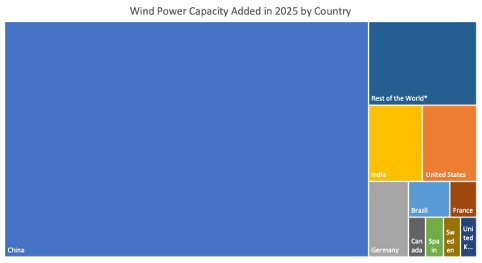
With an additional 6,3 Gigawatt added in 2025, India has improved its position and became the second largest country for new wind capacity, just ahead of the USA. The country stayed the fourth largest market for total installations.
With an overall capacity of 54,5 GW, India surpassed 50’000 Megawatt of installed capacity in 2025 and is expected to reach more than 60 GW in 2026. Given the country’s ambitious targets, India is expected to remain fourth in terms of overall capacity in the coming years. New impetus in India is expected to come from repowering and from offshore wind – which is expected to start in the next few years.
Two more Asian countries can be found amongst the top 20 markets: Vietnam has become one of the most dynamic markets worldwide, reaching 7,4 GW and ranking on 19th place, overtaking Japan which now ranks 20 and has an overall installed capacity of 6,4 GW.
EUROPE
Several European markets showed stronger growth in 2025 then in the previous year, for example Germany, France, Sweden, Turkey, Italy and several eastern European countries. However, the overall picture is mixed, as some of the major markets performed less than in the previous year, for example of the United Kingdom, Spain, Poland or Finland.
While overall Europe had understood the lessons learned from the gas supply crisis caused by the Russian war against Ukraine, and strengthen its efforts to accelerate renewable energy, the fossil and nuclear industry intensified their efforts to weaken legislation on the European level and in some of the EU member states, partially with success. Accordingly, Europe is struggling to maintain its position as a technology leader on the global level. While the US have withdrawn themselves from the renewable energy field, China has become a technical leader and Europe has manoeuvered itself into a defensive role.
Germany improved its market performance for Windpower and increased its market size from 3,2 GW to 4,6 GW in 2025. Considering the project pipeline of permitted projects, it can be expected that such market growth will continue in the near future.
In total, seven European countries surpassed the 1 Gigawatt for new installations, after only five in 2024: Germany, France (1,4 Gigawatt additional, overall 26,1 Gigawatt), Spain (1 Gigawatt added, 33,3 GW in total), the United Kingdom (1 Gigawatt new, 33 Gigawatt in total), Sweden (1 Gigawatt new, total 18 Gigawatt), Turkey (2,1 GW added, 15,9 total) and Lithuania (1,2 GW added, total 2,5 GW).
Medium sized markets between 200 and 600 MW in Europe included Italy (580 MW new), Belgium (535 MW added), Poland (plus 470 MW), Greece (341 MW new) and Austria (244 MW added).
Remarkably, several eastern European states showed very high growth rates, including Lithuania which almost doubled its capacity from 1288 MW to 2510 MW, the attacked country Ukraine which added 325 MW to 2246 MW, Serbia with an additional 464 MW to 1110 MW and Estonia with an increase of 235 MW to a total capacity of 682 MW.
The European Union sent mixed signals regarding the future of renewable energy: while the Commission and the Court of Auditors are still supporting the uptake of energy communities, and the Union has strengthened its efforts to become independent from imported energy, some announcements and decisions have questioned the European direction, for example related to combustion engine cars, the future of nuclear power as well as the climate goals.
NORTH AMERICA
The United States saw around 50% more growth in 2025 than in 2024, adding slightly less than 6,3 GW after 4,2 GW, resulting in almost 161 GW of total capacity. The country remains again only as the third largest market for a new wind turbines, this time taken over by India, while in the previous year Brazil had the third largest number of new installations. As the Trump administration has not only announced but already implemented several decisions which are clearly against new wind farms, the future of the US market is on stake. After courts upheld land use approvals, the US government paid investors for not building wind farms.
However, a rush in new installations is expected in 2026 and 2027 which may bring the US back as the second largest market for these two years, still based on old rules. It remains to be seen how consumers and businesses in the United States will react on policies which are supposed to force them away from cheap and reliable domestic wind power.
Canada installed slightly over 1 GW in 2025, after 1,4 Gigawatt in 2024, and now has 19,5 Gigawatt of capacity – the Canadian economy has still a strong focus on extracting for fuels and the country needs to go a long way. Mexico stayed at 8,7 Gigawatt total capacity in 2025.
SOUTH AMERICA
While Brazil continues to be the leader in South America, its market has lost significant momentum in 2025. The country added 2,2 GW of new capacity, after 5 GW in the previous year, reaching an overall capacity of 35,9 GW. The growth rate fell from 17,7% to 6,7%.
The second largest and second most dynamic market in South America was Chile which increased its capacity from 4,8 GW to 6,0 GW, equaling a growth of 23,9%. Argentina added 177 MW and reached 4,5 GW, followed by Uruguay which remained at 1,5 GW and Peru which added 269 MW and crossed the milestone of 1 Gigawatt of installed capacity, with an annual growth of 36%.
OCEANIA
The Australian wind market stayed in global position 12 with an installed capacity of 15,4 Gigawatt, adding only 94 MW in 2025. Short-term prospects did not appear very bright in the first half of 2025 as no project reached financial close, however, since then the government amended legislation which is seen as favorable for wind power investment, including a new renewable electricity target of 82% in 2030.
New Zealand remained its position 44 with an installed capacity of 1,3 GW.
AFRICA
Although the African continent has a huge twin potential, the installed wind capacity is still rather modest. Amongst the top 30 markets, only one African country can be found: South Africa ranks on place 30 with an installed capacity of 3,7 GW, out of which 203 MW were added in 2025.
The second largest wind power market Egypt remained at an installed capacity of 3 GW (global position 32) while Morocco (number 35 worldwide) added 170 MW and reached 2,4 GW.
As a substantial share of the African population still lives in unserved areas, the market for mini grids has a bigger potential on the continent than in other world regions. So far, such mini grids are mainly based on solar and battery storage but there is an increasing interest in adding wind power as a complementary source, including small and medium size wind turbines.
WWEA President Dr. Irfan Mirza:
The year 2025 marks a significant milestone for global wind energy, with record installations and a growing contribution to the world’s electricity demand. These achievements reaffirm that wind power is no longer an alternative – it is a central pillar of the global energy transformation.
However, the report also highlights an important reality: growth remains uneven and highly concentrated in a few markets. To unlock the full potential of wind energy, particularly outside leading countries, we must accelerate deployment through improved policy frameworks, streamlined permitting, strengthened supply chains, and enhanced capacity building.
Equally critical is meaningful community engagement. The success and sustainability of wind projects depend on ensuring that local communities are informed, involved, and fairly benefit from developments. WWEA’s continued efforts in this area reflect our commitment to inclusive and responsible energy transformation.
Looking ahead, achieving the global vision of significantly expanding wind capacity will require strong international collaboration, innovation, and integrated planning across sectors. WWEA remains committed to supporting this journey and working with stakeholders worldwide to make wind energy a cornerstone of a sustainable and resilient future.
WWEA Secretary General Stefan Gsänger:
At a time when the world is grappling with another escalating fossil fuel crisis, wind power has achieved unprecedented growth. The latest data reveals a record-breaking expansion of global wind capacity, proving that renewable energy is not just a vision for the future, but a tangible reality today.
Yet, this progress also exposes a deeply divided world. On one side, forward-thinking countries are accelerating the transformation to renewables, reaping the economic, social, and environmental rewards. On the other, a small minority clings to the past, rolling back progress through short-sighted policies, fossil fuel subsidies, and misinformation campaigns. These actions inflict harm to people, economies, and the planet.
The facts are undeniable: A renewable-based economy is not only possible – it is essential. Wind power, as a cornerstone of this transformation, offers concrete benefits: energy independence, job creation, lower costs, and a healthier planet. But its success hinges on one critical factor: ensuring that the benefits of renewable energy are shared directly with people, communities, and businesses of all sizes.
Countries and entities that prioritize renewables and inclusive, community-driven energy models will be the leaders of tomorrow. They will not only serve as role models for equitable and sustainable development but also position themselves at the forefront of a global market hungry for renewable energy expertise, technology, and innovation. The opportunity is clear: Those who act today will shape the future of energy.