WWEA Half-year Report 2025: Global Wind Power Growth Accelerates in the First Half of 2025
WWEA Half-year Report 2025
Global Wind Power Growth Accelerates in the First Half of 2025
The report can here be downloaded in pdf format
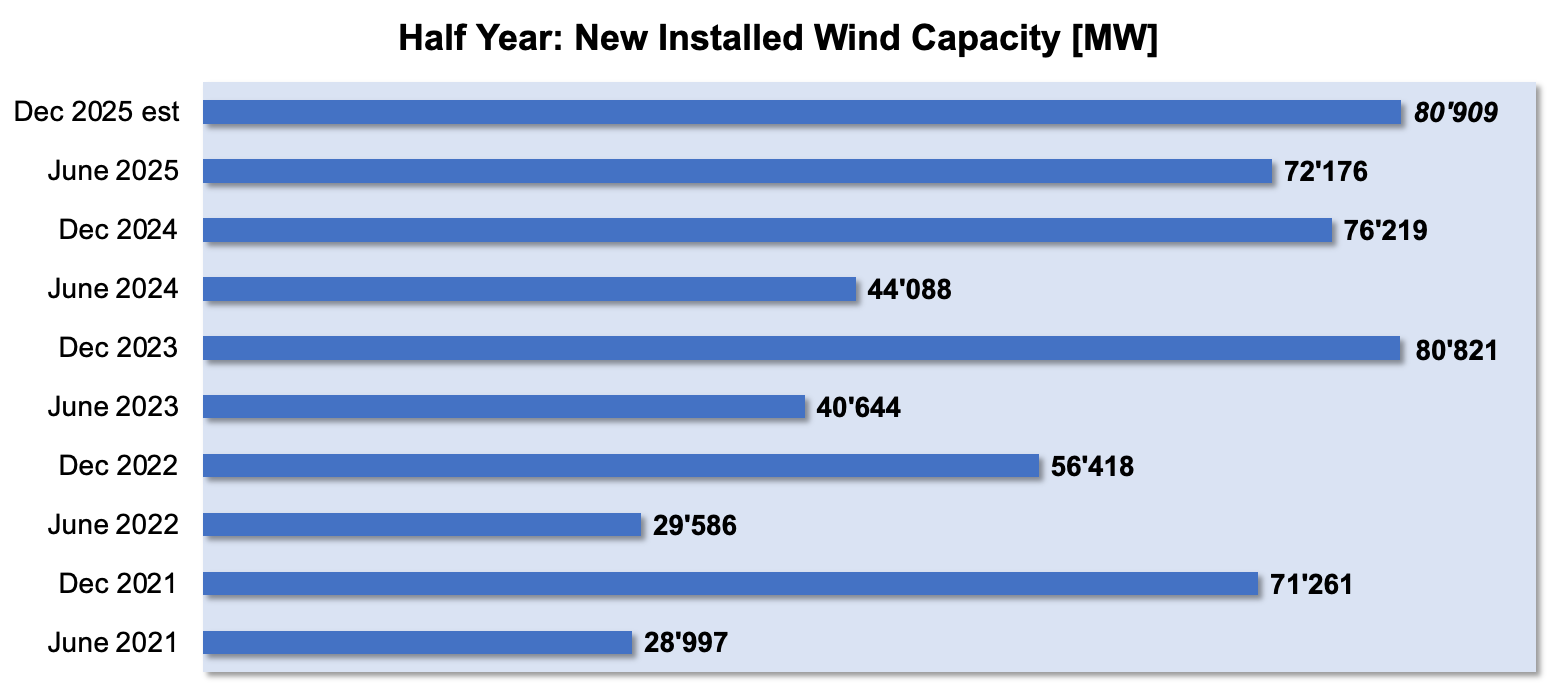
The world’s wind power sector recorded strong growth in the first half of 2025, with global installations rising by 64% compared to the same period of 2024. A total of 72,2 gigawatts (GW) of new capacity were added between January and June 2025, following 44,1 GW installed in the first half of the previous year.
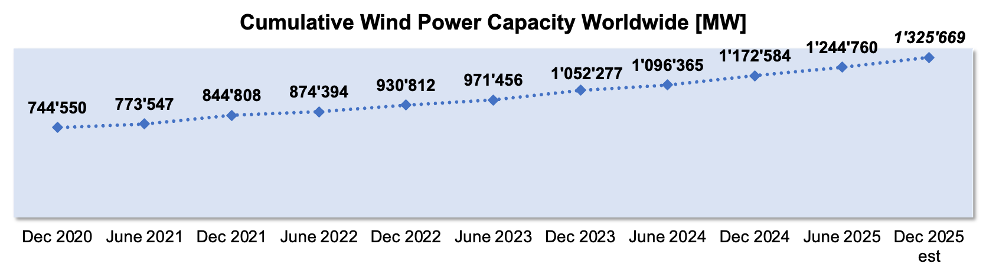
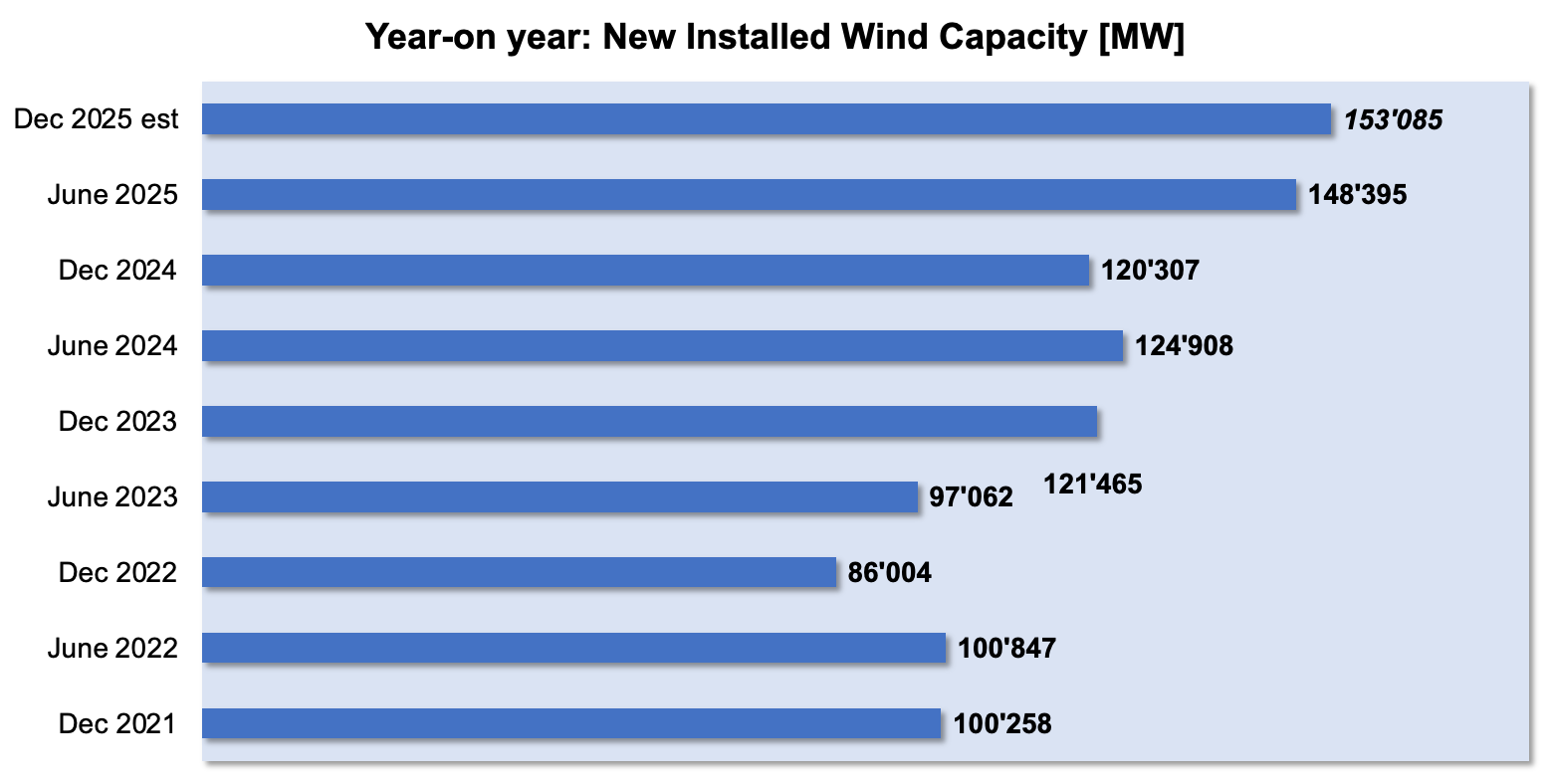
Over the twelve months from July 2024 to June 2025, the sector added 148 GW, compared with 125 GW during the preceding twelve-month period. By the end of June 2025, total installed wind power capacity reached 1’245 GW (1,25 terawatts), representing a 13,5% annual growth rate. Wind energy now provides approximately 12% of global electricity demand.
Highlights
- 72,2 GW added in the first half of 2025, up 64% year-on-year
- 148 GW installed between July 2024 and June 2025
- Global total: 1’245 GW (1,25 TW) as of June 2025
- Annual growth rate: 13,5%
- Wind power share: ~12% of global electricity supply
- China: 51,4 GW added, more than double the previous year
- Full-year 2025 outlook: around 150 GW new installations expected
- Projected total by end-2025: over 1’320 GW
Global Developments
The World Wind Energy Association (WWEA) has compiled statistics on global wind power installations for the first half of 2025, based on data from national associations, official statistics, and WWEA estimates. The figures reflect both confirmed installations and projections for the remainder of the year.
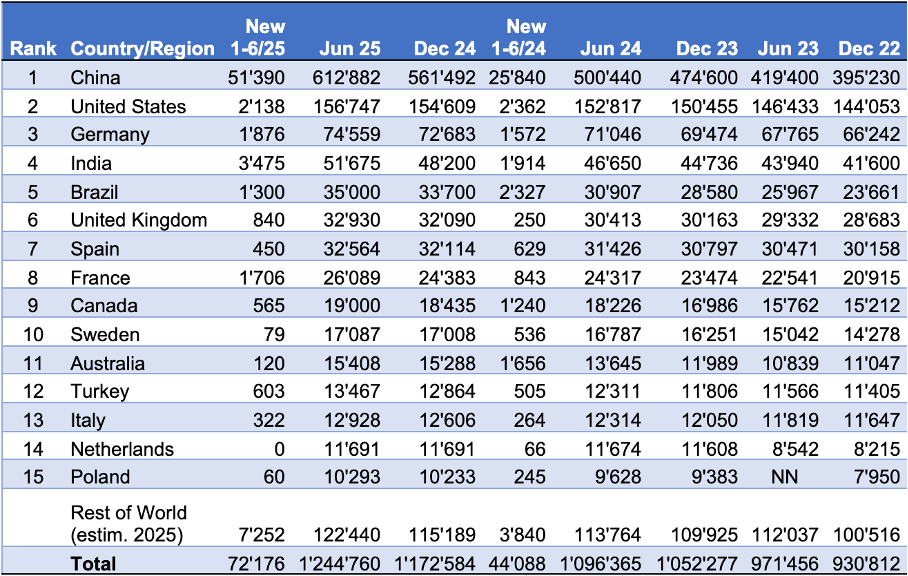
In the first six months of 2025, the world added 72’176 megawatts (72.2 GW) of new capacity — 63,7% more than the 44’088 MW installed during the same period of 2024. This corresponds to a year-on-year increase of 148 GW in total installed capacity, from 1’096 GW in June 2024 to 1’245 GW in June 2025.
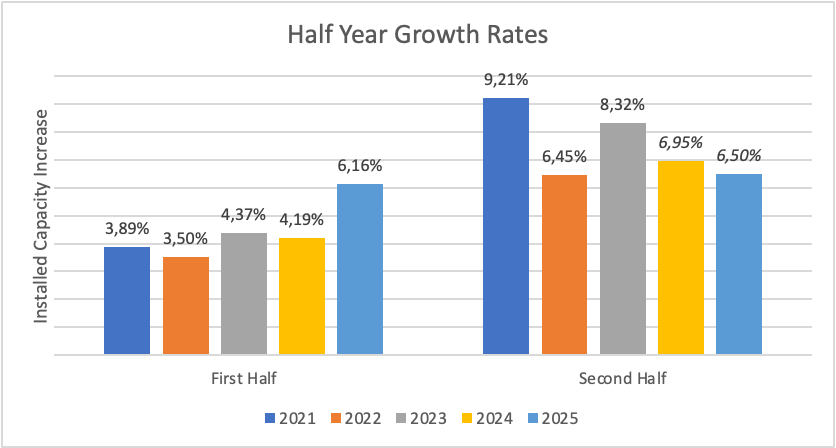
The semiannual growth rate reached 6,2%, compared with 4,2% in the first half of 2024 and 4,4% in 2023, marking a clear acceleration of global wind deployment.
Market Dynamics and Outlook
Delays in several major projects during the second half of 2024 led to slower annual growth that year. Many of these projects were completed in early 2025, contributing to the strong installation figures observed in the first half of the year.
Growing uncertainties in some countries may rather result in more installations this year, as investors rush to benefit from existing frameworks. This may, however, have a slightly negative medium-term impact.
Continued expansion is expected in the second half of 2025. According to WWEA member estimates, total new installations for the full year are likely to reach over 150 GW — a new global record. This would exceed the 120 GW added in 2024, 121 GW in 2023, and 86 GW in 2022.
By the end of 2025, global cumulative wind capacity is projected to exceed 1’320 GW, sufficient to generate around 12% of the world’s electricity.
Country Highlights
China remains by far the world’s largest wind power market. In the first half of 2025, the country installed 51,4 GW, more than double the capacity added during the same period in 2024 (25,8 GW) and in 2023 (23,8 GW). China represents a market share of 72%. With a cumulative total of over 600 GW, China continues to lead global wind development by a wide margin.
Five other countries added more than 1 GW each in the first half of 2025:
- India: 3,5 GW
- United States: 2,1 GW
- Germany: 1,9 GW
- France: 1,7 GW
- Brazil: 1,3 GW
Ranking Changes
Several shifts occurred among the world’s top 15 wind power markets:
- Brazil has consolidated its position as the fifth-largest market worldwide.
- Spain has moved down to seventh place.
- Turkey has overtaken Italy to become the eleventh-largest wind market.
Conclusion
The first half of 2025 demonstrates the continued momentum and resilience of the global wind power sector. Driven by strong growth in China and steady expansion across major markets, wind energy is on course for its strongest year ever. With a record 150 GW expected to be installed in 2025 and a global total surpassing 1,3 terawatts, wind power continues to play a central role in the world’s renewable energy transformation.
The upcoming 22nd World Wind Energy Conference WWEC2025 in Shantou, China from 3 December 2025 to 5 December 2025 will further strengthen global cooperation and set the course for the next phase of wind energy leadership:
WWEA President Dr. Irfan Mirza:
The first half of 2025 has been a defining period for the global wind energy sector – not only for its record-breaking growth but for the clarity it provides about the world’s energy direction. The addition of over 72 GW of new capacity globally demonstrates the sector’s resilience and the trust that governments, investors, and communities continue to place in wind power as a cornerstone of sustainable progress.
At the World Wind Energy Association (WWEA), we are proud to see our members and partners driving this momentum, especially across emerging markets where policy, innovation, and community engagement are increasingly aligned. The significant surge in China’s installations underlines the value of long-term policy stability and industrial strength – lessons that other nations can adapt to their own contexts.
Looking ahead, WWEA remains committed to ensuring that this growth is inclusive, community-centered, and globally harmonized. Our focus extends beyond capacity numbers: we are working with governments, multilateral organizations, and local stakeholders to integrate social, environmental, and economic dimensions into wind energy development. WWEA is launching the community engagement guidelines in its upcoming World Wind Energy Conference (WWEC2025) in China. This will be a defining opportunity to translate this momentum into action – uniting policymakers, industry leaders, and communities to shape a just and accelerated transition toward a 100% renewable energy future.
Together, we reaffirm that wind energy is not only an economic or technological solution – it is a moral imperative for our planet and future generations.
WWEA Secretary General Stefan Gsänger:
The world stands at a decisive energy crossroads.
On one path are the countries that have chosen a clear course toward a fully renewable energy future — led by China, Brazil, and parts of Europe. Many of these countries have established long-term, stable policy frameworks that enable sustained growth of the wind sector and other renewables. Many of them have already set comprehensive strategies for achieving a 100% renewable energy system.
On the other path are countries that are attempting to reverse progress by reviving fossil-based approaches. In these places, including the United States with its new political leadership, the offshore wind sector in particular has suffered significant setbacks, often under pressure from strong fossil fuel and nuclear interest groups.
Given the clear economic, social, and environmental advantages of wind power as a cornerstone of a renewable energy system, the main obstacles to progress today come not from technology or economics, but from vested interests seeking to preserve outdated energy models.
Renewable energy offers vast and undeniable benefits to the great majority of countries and people worldwide. The choice before us is therefore clear — and most countries will find that the path toward a renewable future is not only the right one, but the inevitable one.